UPRT — What the Simulator Cannot Give You
Roy Ben Anat
Aerobatic Pilot
In this article I will try to convey as much practical information as possible on this topic. I want to note upfront that the article reflects my personal opinions, my experience as an aerobatic pilot, and extensive discussions with colleagues who conduct this type of training.
The Beginning: Meeting Keith
My first aerobatics experience was in Florida with Keith Lacttage. Keith is an aerobatic pilot and instructor who, among other things, flies airshows and conducts UPRT programs on an Extra aircraft.
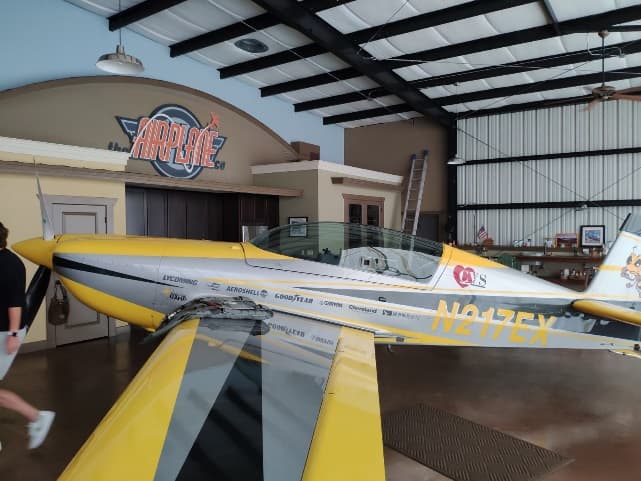
As a pioneer in my close circle who decided to take this step without a military aviation background or significant financial backing, I had to find justification for this path. In long conversations with Keith, I asked him about the employment prospects for aerobatic pilots. As one of the options, he mentioned UPRT.
UPRT: What Is It?
UPRT: Upset Prevention and Recovery Training. A program in which pilots practice unexpected in-flight situations such as upsets, spins, and bank angles higher than usual.
Simulators vs. Real Flight
When we discussed the program, I asked him: pilots train in simulators, what could we aerobatic pilots possibly teach or practice with them?
Like any American, his answer was long and fascinating, but I will summarize it for you: The further we get from training phases and move on to routine flights in "comfortable aircraft," the more our ASS sensors dim. Our field of view narrows from a full picture combining what is happening outside the cockpit and the instrument panel, to the instrument panel alone, and in the glass cockpit era, to a single instrument.
I replied: SO? in an attempt to challenge him. "You're right in normal conditions," he answered, "but in an emergency or when the aircraft is not cooperating, you'd want your pilot to go back to being a pilot, not a systems operator." He told me about phenomena I never thought existed for professional pilots: pilots freezing with the stick pulled to their stomach in an upset, pilots ceasing to function when the aircraft starts spinning, pilots forgetting to "fly the aircraft" when it starts "rebelling" and the alerts and alarms begin.
How many of you have seen episodes of Air Crash Investigation where these topics came up? This is the big advantage of this type of training in the real world: the cockpit is not attached to the floor, and so our body can feel what is about to come, experience it, and recognize it ahead of an emergency I hope my readers never encounter.
Freezing in an Emergency: Three Scenarios
In my experience, not only in flying, one of the causes of the freeze I mentioned is the pressure of the unknown and the unexpected.
The aircraft upsets: wait, that's not what I intended, why is it doing this? The alarms scream, the seat comes slightly away from the seat, and the stress gauge spikes. The aircraft is at 90 degrees bank: what's happening? Why do I see the floor? Why do I feel high G? Why does the aircraft want to increase the bank? Why won't it obey when I put the stick/yoke to the other side? The alarms start and the stress gauge spikes. The aircraft starts spinning: why isn't the trim straightening it? Centrifugal force builds and affects the body, but I have never experienced anything like this, and the stress gauge spikes.
On Spins in Detail
I want to expand on spins. I don't know how many pilots have experienced full spins. In Israel, to the best of my knowledge, spins are practiced only during the basic flight instructor course, and even then it's not a full spin but an approach to a spin (Incipient).
My first time practicing spins was during the preparation for test flights of the aircraft I built (aerobatic DR107). One of the designer's recommendations was: "perform all types of spins."
- Fully developed spin
- Accelerated spin
- Flat spin
The preparation was done in England on a Pitts Special: an aerobatic aircraft with a unique and particularly unforgiving personality.
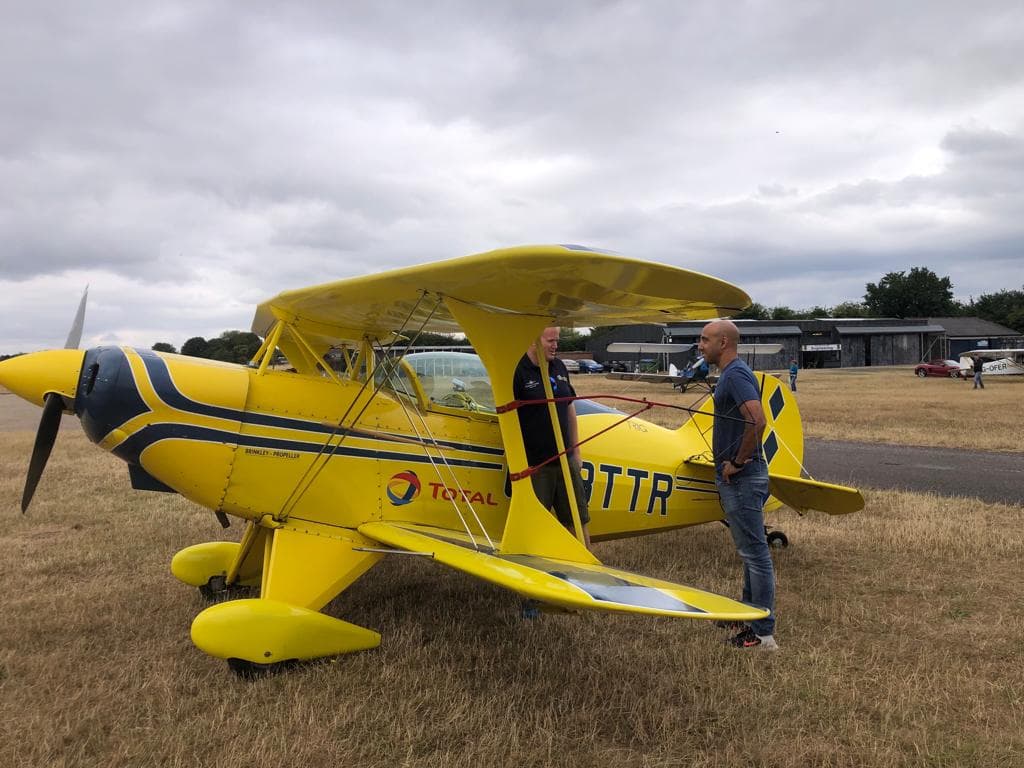
Before the flight, David the instructor said to me: "Spin recovery is a very, very technical procedure. Don't overthink it. Just remember three actions: throttle to idle, hard rudder opposite to the spin direction, stick to neutral. Beyond that, there's no point talking. You need to feel it."
The first practice was to distinguish between the stages of the spin: the approach and the fully developed spin at idle power. The spin entry was not particularly violent and the rotation rate was manageable. The visual field was blurred but overall, not terrible. Unpleasant, but not terrible.
Then came the accelerated spin. Before we did it, David said: "Note: we're going to perform an accelerated spin at full power. Keep in mind that when you begin the recovery, you'll feel the spin accelerating before it slows. At this stage, pilots panic and reverse the rudder direction." The spin entry was at idle, and when I opened the throttle to full power, the spin accelerated in a way I hadn't imagined. The only thing I remember from that first time was immense pressure at my pelvis from the harness keeping me inside the aircraft. I could clearly see both wings but the ground was completely blurred. I felt paralyzed, until David said "OK, recover." The next thing I remember is simply my body reacting, instinctively. My mind was completely switched off, trying to interpret sensations, trying to get information from my eyes, from my ASS, from anything possible, of course without success. But my hands and feet, which had been briefed, responded.
David reminded me: "The rate will increase and then decrease," and it did. All that went through my mind was: WTF?!
In the debrief, he asked me: "How many rotations do you think we did?" I replied I had no idea and that it felt like 10 minutes of non-stop spinning. He answered: it was only 3.
I assume you're asking yourselves: why does the spin accelerate before it slows? He explained: the higher the aircraft's nose, the further we are from the center of the rotation. When we recover, we restore symmetric lift to the wings by reducing the angle of attack. As a result, the aircraft's nose moves closer to the center of the rotation. He gave the example of an ice skater: when the skater extends their arms and legs, the pirouette is slow. When they bring them toward the center, the pirouette accelerates.
The Flat Spin: DR107
Due to focus on touch-and-go practice and landings, we only had a "taste" of the flat spin, and I'll explain immediately why I mentioned this detail. Almost a year later, when testing the aircraft I built, the time came to examine its behavior in spins. Since it's a single-seat aircraft, I had to perform all the test flights alone. Since I barely remembered the flat spin at all, I researched and consulted with colleagues about the aircraft's behavior and recovery techniques.
My friend Gunnar Armin from Brazil (also a DR107 pilot) told me: "The quickest and best way to get out of a flat spin is to put the stick in the forward-left corner, along with hard rudder opposite to the spin direction. This way, even if you leave the throttle at full power, you exit without any problem."
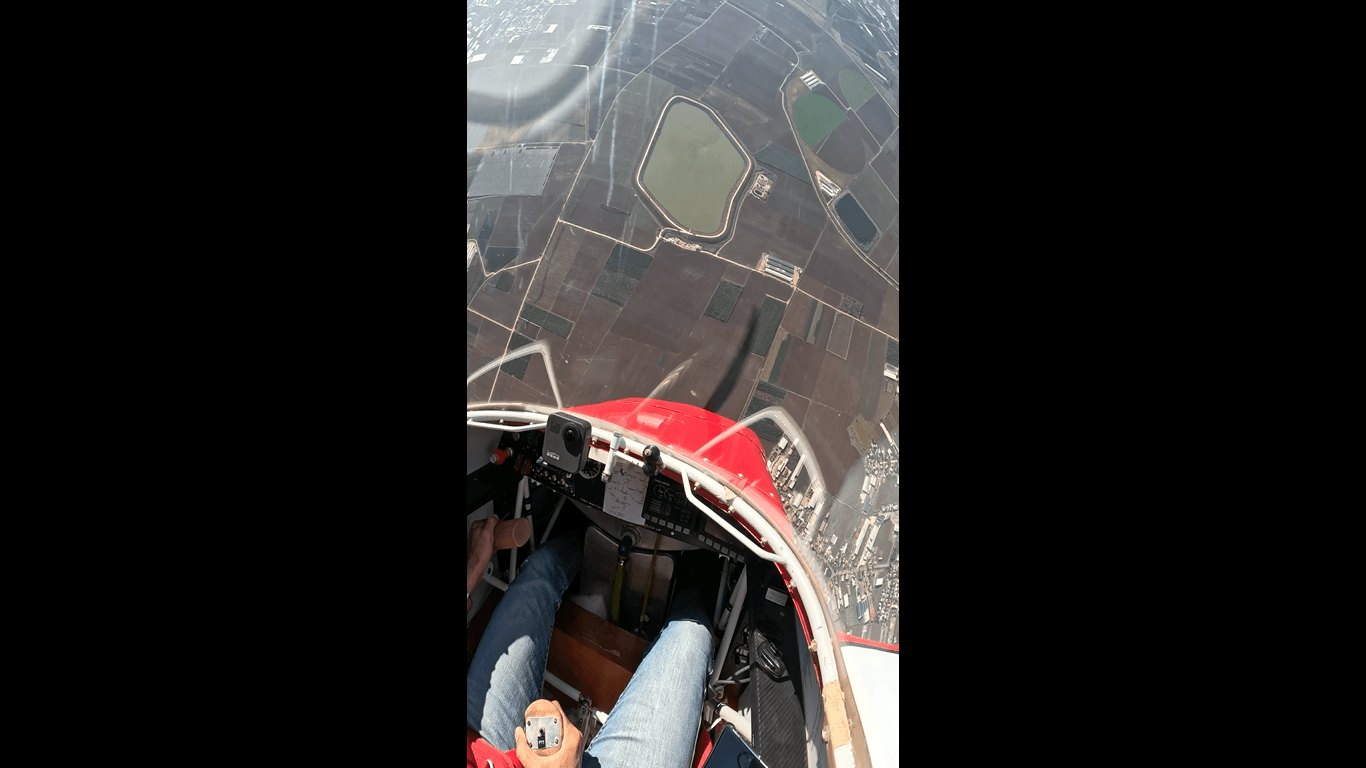
At 6,000 feet I entered a flat spin for the first time in this aircraft. It responded differently from the Pitts. The forces were different from what I had felt before: centrifugal force acting sideways. I felt like I was fighting to keep my head straight against a force pushing it hard to the left.
The Bottom Line: Don't Fight the Aircraft
With these two examples I wanted to illustrate that there are forces and sensations we may encounter in flight, some extreme (spins) and some less so (upsets), but all of them can shift our focus from flying the aircraft to trying to understand what we are feeling. As a result, stress rises, judgment and concentration are impaired, and the aircraft starts "getting ahead of us." When it does, we start fighting it to bring it back to straight and level flight.
But every fight against the aircraft will end in defeat for us pilots.
This is one of the first things you understand in aerobatics and practical UPRT training: experiencing the sensations in the extreme situations I described, and how to function effectively to bring the aircraft where we want it. So if we do find ourselves in a situation, the very fact that we are not experiencing those effects for the first time will significantly help reduce the stress level.
Today, an experienced pilot friend who bought an aerobatic aircraft invites me to fly with him as a safety pilot and coach. He has experience with basic maneuvers and asks me to sharpen him and teach him new things. From time to time I also encounter in him the phenomena I described in this article. Despite being an experienced pilot even in aerobatics, you can feel in the stick the psychological and physiological effects when the aircraft is in an unusual state or enters an unexpected orientation.
All my aerobatic flights I perform alone (unfortunately for now in a single-seat aircraft). I've been asked many times: how do you execute a maneuver for the first time? What happens if it goes wrong? The answer is that I use the same principles practiced in UPRT: don't fight the aircraft, and don't let the aircraft get ahead of you.
Closing: Jim Rohn
I'll close with a quote I love very much by Jim Rohn:
"If you don't use it, you lose it"
And how does this relate to us? At the end of the day we are human beings. In all our courses and licenses we learn how to operate the machine, but what about learning to operate the machine that operates the machine? Our body. If we stop giving our body the real sensations of when the aircraft is not doing what we ask, we will lose those sensations.
I strongly recommend experiencing it. Beyond the important added value, it is a very enjoyable experience. Just be careful: it is addictive.
About the Author
Roy Ben Anat
Aerobatic Pilot